The words spoken by astronaut Neil Armstrong when he became the first man to step foot on the moon — at 10:56 pm Eastern Time on July 20, 1969 — have since become one of the most famous sentences ever uttered.
But NASA’s Mission Control staffers in Houston were moved by a different line, spoken about six hours earlier.
Shortly after 4:05 p.m., the words came across from Armstrong’s fellow astronaut Buzz Aldrin, as the astronauts were looking for their landing spot: “Picking up some dust.”
“When he said that, it sent a chill up my back,” says Gerry Griffin, who was then a 34-year-old flight director. “In fact, I just got the same chill again. It was the first time humans had ever been in a spacecraft with a rocket engine blowing particles off the surface of some place that wasn’t Earth. After that, it felt kind of anticlimactic to me.”
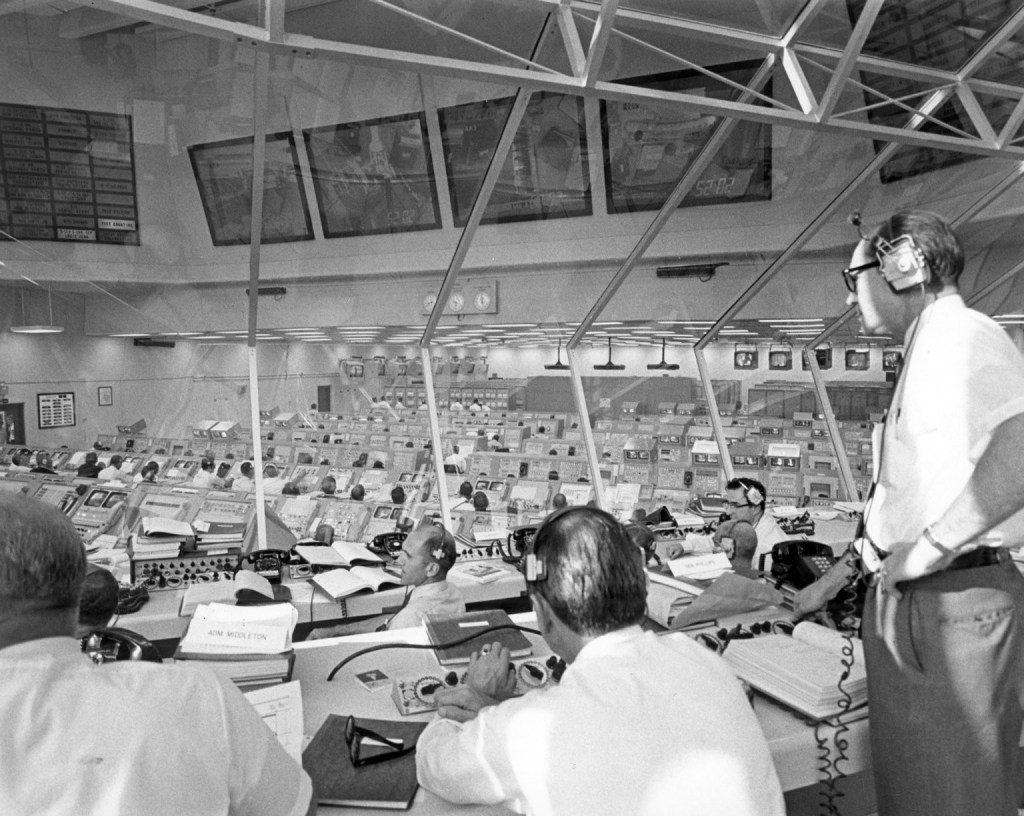
Inside the Mission Operations Control Room — a freezing-cold space in Houston that smelled like coffee and so much tobacco that a cloud of smoke would draft out when the door opened — that dust meant the landing was no longer theoretical. It was going to happen.
Ed Fendell, nicknamed “Captain Video” because he operated the communications system for the “mothership,” the command module, recalls that he felt as if he himself were weightless as soon as he heard those words: “Here we are, the first attempt to land, and I felt like I was levitating over the chair. I didn’t feel like I was touching the chair, or the ground with my feet.”
When three of the footpads of the lunar module nicknamed Eagle touched the surface of the moon, a light flashed. In Houston, Aldrin’s voice could be heard confirming the step: “Contact light.”
Jack Knight, who was a 25-year-old flight controller who monitored the lunar module, gets choked up when he recalls that line 50 years later. “Then, I knew they were going to land,” he says, in tears.
At 4:18 p.m., Armstrong radioed: “Houston, Tranquility Base here. The Eagle has landed.”
‘I Never Felt So Proud’
“I was so excited, I couldn’t even say Tranquility,” Duke says. “The tension evaporated [after that].”
Fifty years later, Duke says he found it “easier” to be the one actually landing a spacecraft on the moon — which he did during Apollo 16 in 1972 — than to monitor this one from Mission Control down on Earth. “I was much more confident and relaxed” in space. “You’re looking out, seeing it, feeling the spacecraft as it maneuvers, [rather] than looking at charts and lines on a computer screen.”
But the successful landing didn’t mean the astronauts were out of danger.
As people around the world began to celebrate, the men in Mission Control knew their work wasn’t yet done. The 35-year-old flight director Gene Kranz, whom TIME described as “a crew-cut and clip-voiced former test pilot,” started to get annoyed by the whooping and hollering of the VIPs in the viewing room behind him. “They start cheering and stomping their feet, and that sound seeps into the room at a time when we have to concentrate,” he says. “I get sort of angry. I sort of yelled at everybody to settle down.” He even broke his penciland it flew up in the air. The crew still had to do the post-landing checklist.
“The crew has just landed,” he explains, “and we have to make sure it is safe to remain there and we have to do it at very specific times, when the lunar module could lift off and do a rendez-vous with the command module that’s orbiting the moon.”
After getting the clear that it was safe to stay, Neil Armstrong climbed down the ladder of the lunar module and spoke his famous words. Pete Conrad, who would become the third man to walk on the moon during Apollo 12, had come to watch and remarked that it was “just like Armstrong to say something profound like that,” remembers Jerry Bostick, who back then was the 30-year-old leader of a team of flight controllers in “the trench,” the nickname for the first row of consoles.
John Aaron, who was a 26-year-old subsystems flight controller for the command module, was done with his shift after the landing, but didn’t want to go home yet. He stepped outside for a cigarette. On that humid evening, the man with a reputation for sangfroid looked up at the sky in a new way.
“I was looking at the moon, the real moon, and I just felt, Oh wow. There it is. We’re there. That’s when it really hit me, the emotional drain,” he says. “When they actually landed, I remember the hair on the back of my neck standing up just a little bit, but when I saw the moon, it was just…wow.”
The morning after the astronauts walked on the moon, two guys who worked at the gas station nearby approached Fendell while he was eating scrambled eggs in a coffee shop. “One of them said, you know, I landed in Normandy on D-Day, and I never felt so proud to be an American as I was yesterday,” Fendell tells TIME. “And it finally hit me as to what we had done. It hadn’t really registered [to me] what it meant to the outside world. I threw my money down, went in my car and cried in the car.”

 ORDERLINEGlobal